The Star Grows Further — From Three Stages to Five
The star next to a task was fully grown after just three things were filled in. Nothing you wrote after that changed it. Here is how we stretched it to five stages, with a gold halo that grows along with each one.
It started with one question: how could filling in every field be something you enjoy?
A task in fecit has many places to write — tactics, hope, current, obstacle, preparation, steps, result, retrospect. How much of that you have filled in is shown by the star next to the task. It is the star we wrote about six months ago in The Star That Grows.
That star finished growing too early.
A star that stopped at three
The star follows a single score. The rule is simple.
- Each text field (tactics, hope, current, obstacle, stakes, result, retrospect) is worth 1 point if it has anything in it
- A satisfaction rating is worth 1 point
- Every preparation item, step, and response rule is worth 1 point each
There is no upper limit. But the star had only three shapes: just the star at 0, four dots at the corners at 1–2, and short lines from 3 up.
So three preparation items were enough to reach the final shape. After that you could write your hope, work through the obstacles, finish the task and leave a retrospect, and the star stayed the same. From the fourth thing on, the star had nothing to say.
Six months ago we cut it down to three stages because we thought more stages would dilute the meaning. In use, the problem was on the other side. The stages ended so early that most of the filling-in never showed up in the star.
Five stages
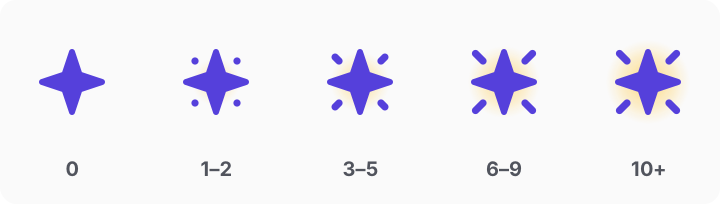
We kept the way the score is counted and only split it into five ranges.
- 0 — just the star.
- 1–2 — dots at the four corners.
- 3–5 — the dots become short lines.
- 6–9 — the lines get longer.
- 10 or more — the lines stay, and the halo is at its largest.
Filling in every text field and leaving a satisfaction rating gives 8 points. It takes a few preparation items or steps on top of that to reach the last stage. We expect to adjust the numbers as we use it.
What we threw away
We drew several ideas on the way here and dropped them.
A meaning for each corner. Each of the four corners would stand for one group — analysis, plan, preparation, reflection — and only the corners of the groups you had filled would grow. The appeal was that the star alone would tell you what was still empty. Drawn out, the star leaned to one side and did not look good, and you had to memorize which corner meant what. We decided the four corners always grow together.
More lines, or a ring, when everything is filled. Eight lines, twelve lines, or the lines turning into a ring around the star. Drawn large they looked rich, but at the size the star has in a list they clumped into a smudge, and the ring read as a different icon rather than a star that had grown.
Branches growing out of the star. No dots or lines; branches grow from the body of the star until it has eight points. This had the strongest sense of growth, but it changed the character of the star we have now.
What we kept is the grammar that was already there. Dots appear, and dots stretch into lines.
The halo
That left the question of how to mark the last stage. Instead of making the shape more complicated, we put light behind the star.
At first only the fully grown star had a halo. That made the halo appear all at once at the end. So we changed it to start small at the first stage and get a little wider and brighter with each one.
We changed the color once, too. At first the halo was a faint wash of the star’s own color. That was fine for bright stars, but behind dark or gray stars it looked like dirt, not light. A task with no color chosen has a gray star, so the most common star was the one that looked the dirtiest. The halo is now one gold, whatever the star’s color. The star itself keeps the color you chose.
The halo does not spread outside the space the star occupies, so that it never touches the text beside it in a list. Stars that sit on a filled color, such as calendar bars, get no halo.
The moment it grows
When you fill something in and the score crosses into the next range, the star on screen grows right where it is. Over 0.45 seconds it moves from the old shape to the new one and gives a small pop.
A dot is drawn as a line of length zero. So the dot does not vanish and a line appear in its place — the dot itself stretches out into the line.
Nothing moves when you first open a list. If every star grew each time you opened it, the moment of actually growing would get lost.
Back in code
Six months ago we pulled the shape of each stage out into three image files. The code got simpler, and we wrote in that post that “some decisions are more flexible when they aren’t made in code.”
This time we reversed that. Three images cannot draw the path between one stage and the next; you need the shapes in between a dot and a line. The star is drawn by code again. In exchange, the shape of every stage lives in a single table, and the mobile and desktop apps read the same one.
On mobile we also made the star a little bigger, from 14 to 18. That is the size at which the difference between stages became visible.
Still a mirror
The star is still not a reward. It has no number and no message, and there is nothing to collect or trade. It only gives back, as a shape, what is written in that task.
Whether filling in the fields has become enjoyable is something we will find out by using it. But now the star changes when you fill in the fourth one.